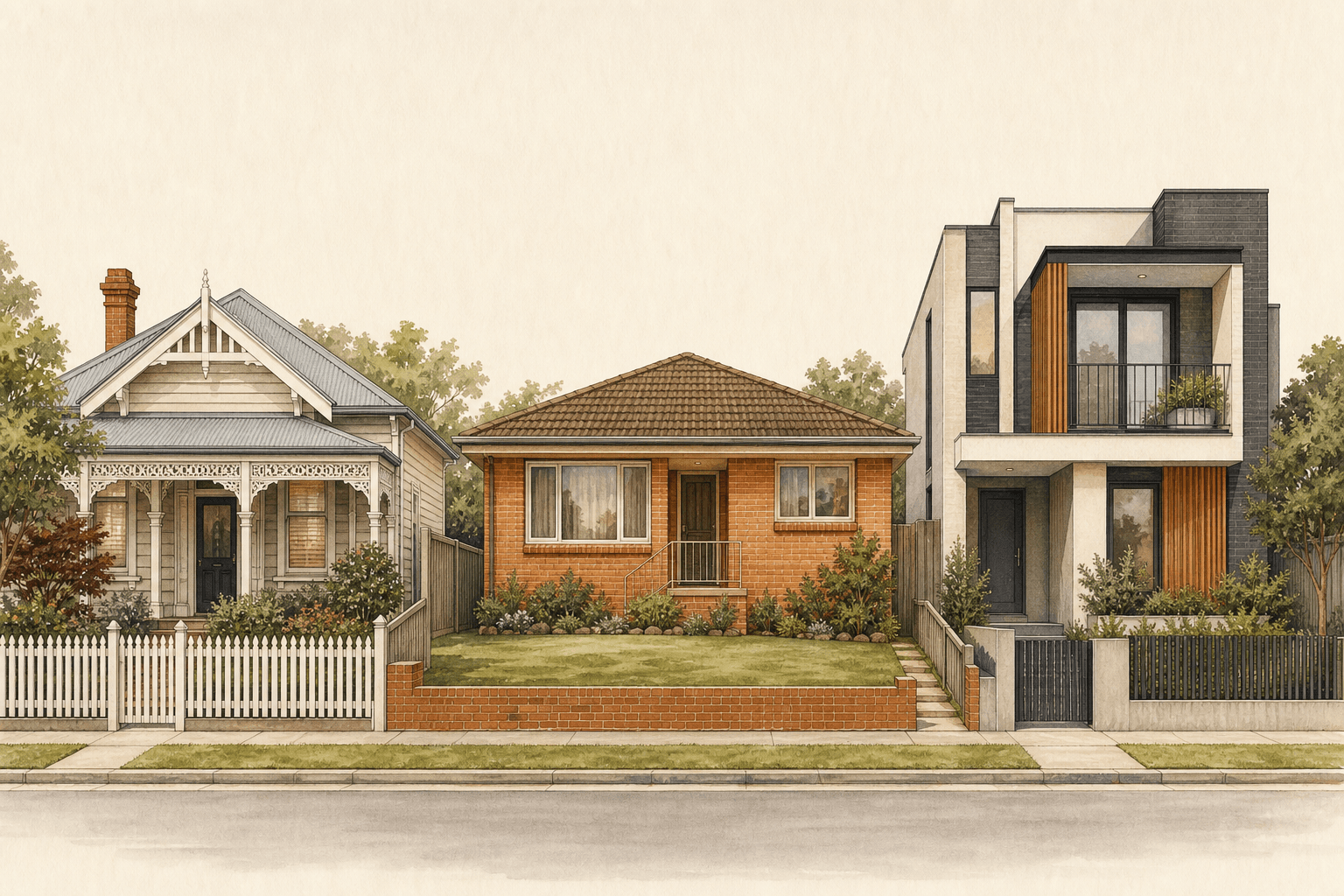
You may have seen the statistic: 55.8% of Australian household wealth sits in residential property. The RBA Household Sector Chart Pack and the ABS Survey of Income and Housing both report this figure, and it turns up regularly in news coverage and policy discussions. It is accurate. It is also, on its own, not that useful for understanding your own situation.
The reason is that 55.8% is a national average. It is produced by adding up every Australian household — people with very different amounts of property, debt, super, and savings — and dividing. The result describes no single household in particular.
Three households could each hold property at very different shares of their wealth — say 80%, 65%, and 20% — and still average out to around 55%. None of them actually sits at the average. The headline number hides that spread.
What "concentration" means in plain English
Concentration just means how much of your wealth is tied up in one type of asset. If a large share of what you own is property, a rise in property values helps you, and a fall hurts you — more so than someone whose wealth is spread across different things.
The ABS Survey of Income and Housing data shows owner-occupied dwellings and other property together represented approximately 55% of total household assets in 2021–22, with residential property the dominant part of that. For most Australian households, that is not an accident — the system was set up for decades to make home ownership the main way people built savings.
The three types of household behind that average
Home-rich, cash-poor. This is often retirees or people approaching retirement who own their home outright but hold limited savings in other forms. The home might represent 70, 80, or even 90% of their total net assets. Their high property concentration is not really a choice they can easily undo — selling the family home is not just a financial decision, it is a housing decision. The concentration is real, but the options for changing it are limited.
Property investors with debt. This group owns a home plus one to three investment properties, often still with significant mortgages. When you add up all their property holdings, their concentration in residential property frequently sits above 70 or 80% — consistent with the upper quintile property-asset share data in the ABS Survey of Income and Housing 2021–22. They have the most flexibility to reduce that concentration by selling an investment property, though capital gains tax and selling costs make it less straightforward than it sounds. The RBA's Financial Stability Review (October 2025) and Statement of Monetary Policy (February 2026) identify this group as the one where concentrated, leveraged property exposure creates the most financial risk in a downturn.
Diversified and wealthy. This group owns a home, but also holds substantial superannuation, shares, and savings. Their property concentration might sit at 30 to 40% of total net wealth — well below the national average. They are included in the same calculation that produces 55.8%, but the number does not describe them. Their presence in the data pulls the average up without the headline figure reflecting their actual position.
The national 55.8% average sits between the lower end of the diversified-wealthy group and the upper end of the home-rich, cash-poor group. It describes neither accurately.
The part of your property exposure you can actually act on
The RBA makes a distinction worth knowing about. Your gross property concentration includes your home. Your discretionary property concentration excludes it, on the basis that most people cannot sell their home without also solving a housing problem.
When the family home is set aside, the RBA's Household Sector Chart Pack and Financial Stability Review (October 2025) data show discretionary property concentration — investment properties and other residential holdings outside the primary residence — running at roughly 30 to 40% of total discretionary wealth for the average household. That is meaningfully lower than the gross 55.8%, and it is the part of your exposure that can genuinely be weighed as a financial decision.
What this means for your property plans
If you are buying your first home, or thinking about an investment property, the 55.8% figure is useful context — but your household's own version of that number is what matters.
A 20 to 30% correction in residential property values would affect the gross figure for everyone. For people carrying mortgage debt on investment properties, it would increase their loan-to-value ratios at the same time. That is not a reason to avoid property, but it is a reason to understand where your own concentration sits before making a decision.
The 55.8% headline is the start of that question. Your household's actual split — across property, super, savings, and other assets — is the answer that matters to you.
Every fact in this article traces to a primary source. See our standards and corrections register.